
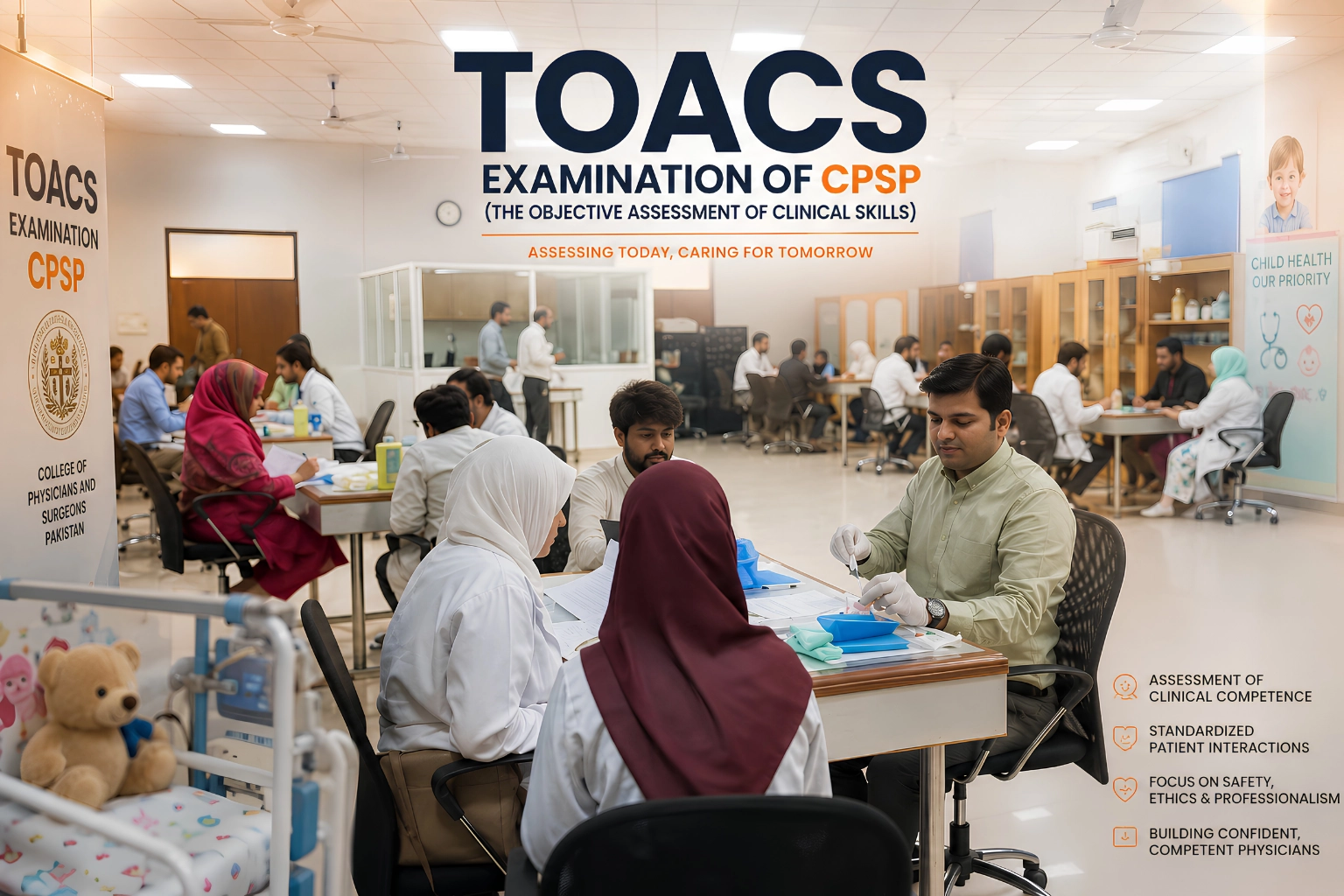
Every batch of IMM Pediatrics TOACS I teach arrives carrying the same sentence: nobody passes TOACS on the first attempt. Someone senior said it, someone else repeated it, and by the time candidates reach me they have quietly decided that this sitting is a rehearsal. That belief costs more marks than any knowledge gap I have ever seen. It makes people book the exam without preparing properly, then walk into the hall expecting the outcome they were promised.
I want to argue against that, because the IMM Pediatric TOACS is not built to fail you. It is built to check whether you are safe, systematic and able to say out loud what you already do on the ward every day. The candidates who struggle are rarely the weak ones. They are competent residents who never practised the specific performance this exam asks for, which is what our IMM Pediatrics TOACS course exists to fix.
What the IMM Pediatric TOACS actually is
You rotate through a series of structured stations, moving on when the bell goes. CPSP guidance describes two kinds. At static stations there is no examiner and you write your responses on a sheet. At interactive stations one examiner is present, gives you a task, watches you do it and asks questions.
Station numbers and timings vary between sittings and centres, and the published guidance gives a range rather than a fixed figure, so treat any number you hear in the ward as approximate and check your own instructions. What does not vary is the shape of the thing: a fixed clock, a standardised rubric, and an examiner marking what you actually said rather than what you meant.
Two rules from the official guidance that catch people out. Every station must be attempted, so a blank sheet at a static station is simply forfeited marks. And you carry only your response sheet between stations, with no notes or materials of your own.
The station map you can plan around
The value of knowing the blueprint is that it turns revision into a checklist. Across sittings, the IMM Pediatric TOACS keeps returning to the same territory:
| Station type | What it tests |
|---|---|
| Emergency procedures | Hands-on technique, sterile steps, equipment sizes |
| Neonatal resuscitation | Protocol adherence, hand positioning, sequence |
| Emergency management | Acute stabilisation in the ER |
| Dermatology | Visual diagnosis and management |
| Psychiatry and developmental pediatrics | Milestones, autism, ADHD |
| ECG and EEG | Pediatric rhythms, blocks, seizure waveforms |
| Neurology with imaging | Clinical case paired with a CT scan |
| Poisoning | Antidotes, mechanisms, toxicity grading |
| Genetics | Pedigree interpretation and inheritance patterns |
| Radiology | Systematic reading of plain films |
| Approach-based stations | Structured clinical reasoning, start to finish |
If poisoning, radiology, developmental pediatrics and procedures are effectively guaranteed, those are where your last month of revision belongs. There is no reward for surprising yourself on exam day.
Approach-based stations
These are the ones that frighten people most, and they are the most predictable of all once you understand what is wanted.
You get a single line. A three year old presents to the ER with periorbital puffiness, how will you approach this case. The wrong answer is “nephrotic syndrome”, said quickly and correctly. The examiner is not asking for the diagnosis. They are asking you to walk from the door to the management plan out loud.
The structure that works in the IMM Pediatric TOACS:
- Open with your differentials, so the examiner knows where your thinking is going
- Take a targeted history, with the examiner usually role-playing the mother
- State the examination you would perform and what you are looking for
- Order baseline and then specific investigations, and ask for the results
- Build a management plan from what comes back
The examiner will feed you results and steer you gently toward the diagnosis. That only works if the theory underneath is solid. You cannot reason your way through a child with purpuric spots after a viral illness without already knowing what separates ITP from HSP from leukemia.
Why competent residents fail
Nearly every failure I review comes from method rather than medicine.
Treating theory and performance as the same skill. Recognising the right answer among five options is a different act from constructing a case out loud under a clock. On the ward you take shortcuts, and rightly so. In the IMM Pediatric TOACS those shortcuts read as gaps.
Being vague about procedures you do weekly. You have done lumbar punctures, needle thoracostomies, IV lines. The examiner wants needle size, sample volume, number of vials, the specific sterile steps. In a resuscitation station a wrongly positioned hand on the mask can cost you the mark regardless of how many babies you have actually resuscitated.
Not knowing complications. Ward routine rarely tests you on the complications of an intraosseous line or a lumbar puncture, and examiners ask constantly.
Not recognising instruments. If your hospital does not do bone marrow or renal biopsies, you may never have held a Jamshidi or Tru-Cut needle, or seen a peritoneal dialysis catheter. These are free marks for candidates who spent an afternoon learning what they look like.
Reading three summary books on one topic. Local guides contradict each other on things like the steps of a water deprivation test. Pick one standard source or your own hospital protocol and stay with it.
Panicking at an image. A child with diarrhea who starts seizing, presented alongside a CT scan. Candidates who cannot read neuroimaging spend the whole station staring at the film. The imaging is usually a small part of the marks and the stabilisation, anticonvulsant and investigations are the rest. Never let one image swallow a station.
Emptying the tank in two minutes. In a diabetic ketoacidosis station, nervous candidates recite fluids, insulin rate and potassium monitoring in one breath. Then six minutes remain, the examiner says “and then?”, and there is nothing left. Pace yourself. Two points, then pause.
What to do instead
Preparation for the IMM Pediatric TOACS starts with theory and then polishes it. The knowledge you accumulated for the theory paper is the raw material for every approach station. Nelson stays a reference for targeted topics, not a book to reread the week before.
Then the specifics:
- Lock down the guaranteed stations. Basic pediatric rhythms and blocks, a systematic format for reading films, poisoning antidotes and grading, and the visual appearance of common instruments.
- Practise speaking. Most residents have not sat a formal viva since house job, and the first time should not be in front of a professor who is marking you. Form a group, time each other, present cases out loud until it stops feeling strange.
- Treat each station as a conversation. Offer two relevant points, stop, let the examiner prompt. The back and forth fills the time and reads as composure.
- Dress formally with a clean, pressed white coat. It sounds trivial and it is not. Examiners form an impression before you speak.
- Never argue. Some examiners push back deliberately to see how you handle pressure, occasionally insisting you did not say something you definitely said. Agree, apologise, move forward. Being right is worth nothing here.
- Say you do not know. If you cannot recall the grading of paracetamol toxicity, say so plainly. Guess, and the examiner follows your wrong answer down a corridor you cannot escape, burning minutes you needed.
Surviving the hall itself
Compartmentalize. You have a margin of error across the IMM Pediatric TOACS, and one weak station does not sink you if the rest are solid. What does sink people is carrying the last cubicle into the next one. I have watched a candidate fail three stations in a row because of one bad opening.
The reset takes ten seconds. Walk out, breathe out slowly, and tell yourself the previous station is now somebody else’s problem. The next examiner has no idea what just happened and no interest in it. Give them a candidate who looks like they have had a good morning.
Where to start
Work backwards from your sitting. Give the final six weeks to the guaranteed stations and to speaking out loud, and stop reading new material in the last week. Book three mock vivas with colleagues who will be genuinely hard on you, because a friendly mock teaches you nothing about performing under pressure.
If you want that practice supervised, our IMM Pediatrics TOACS course runs timed station circuits with feedback on how you present, not only on what you know. Candidates still working through the written paper should start with the IMM Pediatrics theory course, and you can see who teaches each component on our mentors page.
The myth about second attempts survives because it is comforting. Give the IMM Pediatric TOACS the tactical preparation it actually asks for, and there is no reason your first attempt should not be your last.
FAQs
How many stations are there and how long is each one? CPSP guidance gives a range rather than a fixed number, with stations of a few minutes each, and the details vary by sitting and centre. Check the instructions issued with your own exam.
What is the difference between static and interactive stations? Static stations have no examiner and you write your answers on a response sheet. Interactive stations have one examiner who sets a task, observes you and asks questions.
Can I fail a station and still pass overall? The exam is scored across all stations, so a single weak station is survivable when the rest are solid. The bigger risk is letting one bad station affect the next three.
What if I genuinely do not know an answer? Say so politely and let the examiner move on. Guessing invites deeper questioning on ground you cannot defend, and costs time you need.
Does what I wear actually matter? Yes. Formal clothes and a clean white coat cost you nothing and shape the examiner’s first impression before you have said a word.
How do I prepare for approach-based stations? Practice out loud, in the order the IMM Pediatric TOACS rewards: differentials, history, examination, investigations, management. The structure matters as much as the content.
Sources and resources
- Watch the full webinar, the hour-long session this article is drawn from
- CPSP IMM examination guidelines, for the exam process, scheduling and hall regulations
- College of Physicians and Surgeons Pakistan, for eligibility, application forms and examination centres
- Nelson Textbook of Pediatrics, for the theory underneath every approach station
- Your own hospital protocols, as the single source for procedural steps rather than competing summary guides