
Every year I meet doctors who studied harder for the IMM Pediatrics Theory than I did and still failed. They had read Nelson twice. They could talk through a case beautifully on a ward round. Then they sat down in front of a screen, met a paragraph-long stem with a missing full stop, and lost twenty minutes to panic before they had settled. The IMM theory paper does not really ask whether you know pediatrics. It asks whether you can retrieve what you know, quickly, under a clock, on a bad morning.
That gap between knowing and retrieving is what this article is about. I have taught this exam for a few years now, and the candidates who clear it on the first attempt are usually doing four or five specific things differently, none of which involve reading more. Below is the pattern, the marking, the habits that fail people, and the ones I now insist on in our IMM Pediatrics course.
What the IMM Pediatrics Theory paper actually looks like
The IMM Pediatrics Theory consists of Two papers, one day. Each has 100 single best answer MCQs and runs for two hours, which is what the CPSP guidelines specify for pediatrics.
Single best answer is the part people underestimate. Two or three options can be clinically defensible. You are being asked which one fits this particular stem best, which is a different mental operation from recalling a fact.
A typical exam day runs like this, though you should always confirm against your own admit card:
| Time | What happens |
|---|---|
| 8:30 to 10:30 | Paper 1, 100 MCQs |
| 10:30 to 11:00 | Break, usually with a light lunch provided |
| 11:00 to 1:00 | Paper 2, 100 MCQs |
Two hours for 100 questions gives you 1 minute 12 seconds each. That sounds brutal and is not, because the distribution is uneven. A one-line recall question takes thirty seconds and banks you time for the three-paragraph neonatal scenario that genuinely needs two minutes of thinking. The candidates who run out of time are almost never short of knowledge. They spent four minutes each on six questions early in the paper.
Note that papers sat outside Pakistan follow the conventional format with a different duration, so check the guidelines if you are applying from abroad.
How the marking actually works
There is no negative marking in IMM Pediatrics Theory, so a blank answer is a mark you have thrown away. Answer everything, even the ones you are guessing on.
Beyond that, be careful what you believe. Candidates trade a lot of confident theories about percentile scoring and question weighting, and the honest position is that CPSP does not publish the exact formula. What I tell my students is this: the paper is scored in a way that accounts for how the whole cohort performed, which means you cannot reliably predict your result by counting how many you thought you got right. An easy paper is easy for everybody.
Two working rules I give candidates, both drawn from years of post-exam recalls rather than from any official document:
- Aim to keep your total incorrect answers well under thirty across both papers. Treat that as a target for preparation, not a promise about the result.
- Do not plan to rescue a weak Paper 1 with a strong Paper 2. Consistency across both is what gets counted, and I have watched candidates with an excellent second paper still not clear.
The mistakes that fail good doctors
Almost every failure I review comes down to method rather than ability.
Reading Nelson cover to cover is the biggest one. It is a multi-volume text and you have three to four months, not eighteen. Passive reading also gives you recognition rather than recall: the information feels familiar when you see it, and refuses to surface when a stem needs it. Use Nelson for targeted topics, opened because a question sent you there.
Separating reading from questions is the second. Studying neonatology for a week and saving the MCQs for the end of the month wastes most of the benefit. Solve questions on the same day you cover the topic, while the material is still soft enough to reshape.
Reading the options before the stem is the third, and it is advice that gets passed down every year as a time-saving hack. It is not. Options seen first bias you toward a diagnosis before you have met the patient, and IMM Pediatrics Theory stems are built to punish exactly that. Read from the first line.
Skipping past papers is the fourth. The wording changes each sitting, the topics do not move much. If one sitting asked about the definition of respiratory distress syndrome, the next may ask about its complications. Past papers show you the blueprint even when they do not show you the questions.
What to do instead
Give yourself four months. Colleagues who claim they cleared it in six weeks are either unusual or misremembering, and neither is a plan. On non-call days, aim for a long study block of eight hours or so, and be realistic about what your roster actually allows rather than designing a schedule you will abandon in week two.
The rest of it:
- Work from question banks first, then open the textbook. Standard IMM Pediatrics Theory and FCPS banks, Pre-Test Pediatrics for volume, and Rudolph’s Pediatrics when a concept refuses to make sense.
- Track which topics keep reappearing across banks. That list is your reading list.
- Make handwritten notes, even scrappy ones. Writing by hand gives you a visual page to picture in the hall, which typed notes rarely do.
- Learn the alternate and older names of diseases. Examiners withhold the familiar name surprisingly often, and a candidate who only knows one label for a condition simply does not recognize the question.
- Use current sources for anything contested. The Nelson 22nd edition and QBank settle arguments that ward folklore cannot.
Exam-day psychology
Use the skip button. Because nothing is negatively marked, people feel obliged to answer immediately, and then sink three minutes into one confusing stem. If you have read a question twice without traction, skip it. Skipped questions wait for you at the end, and you will meet them again with the easy marks already banked and your pulse lower.
Do not fight the grammar. Examiners are human and a missing full stop can make it unclear whether a symptom belongs to the patient or the sibling. Read for clinical sense rather than for syntax. A large part of the paper is solvable with the common sense you built on the wards.
Expect a bad run. Because questions are drawn from pools, you can hit twenty difficult ones in a row through pure chance. Your heart rate climbs, and the urge to abandon the exam feels weirdly reasonable. When that happens, take your hands off the mouse, close your eyes, and slow your breathing deliberately: in for four seconds, hold for five, out for seven. One minute spent settling beats twenty questions answered in a blind rush.
Watch for the small words. Under pressure your brain edits them out.
| Trap word | What it changes |
|---|---|
| Except, not | Inverts the whole question |
| Preceded by, followed by | Reverses the sequence you are being asked about |
| First step | Asks for the immediate action, not the definitive one |
| Most accurate | Asks for the gold standard, not the practical first move |
The last twenty-four hours
You can prepare well for four months and undo it in one night.
Do not cram the night before. Sleep loss degrades exactly the functions this paper tests: sustained attention, reading accuracy, and speed of recall. Nearly every candidate who tells me they misread a question, or missed the word “not”, sat that paper on four hours of sleep. Leaving one minor topic unread and getting six or seven hours is the better trade, every time.
Eat something. If nerves make a full breakfast impossible, carry dates and some dark chocolate. You are sitting a four and a half hour mental task and your concentration will follow your blood sugar whether you planned for it or not.
Where to start
Pick your sitting, count backwards four months, and put the start date in your calendar this week. Then set up the loop that does the actual work: a topic in the morning, that topic’s MCQs the same evening, handwritten notes as you go, and a full timed paper every weekend from month three onward.
If you would rather have that structure built for you, our IMM Pediatrics course runs unit by unit in five-day blocks, with lectures mapped to past question lines, weekly MCQ sets, and mocks under exam timing. Candidates already past IMM can look at the FCPS Part 2 Pediatrics course, and you can see who teaches what on our mentors page.
FAQs
How many questions are there and how long do I get? Two papers, 100 single best answer MCQs each, two hours per paper for pediatrics candidates sitting in Pakistan.
Is there negative marking? No. Leave nothing blank, and guess on anything you cannot resolve.
Can I pass one paper and carry it forward? No. Both papers count together, which is why a strong second paper does not rescue a weak first one.
How long should I prepare for? Four months of consistent work suits most candidates alongside clinical duties. Shorter plans tend to produce recognition rather than recall.
Do I need to read Nelson completely? No, and trying is the most common preparation mistake. Use it for targeted topics that your question practice has flagged.
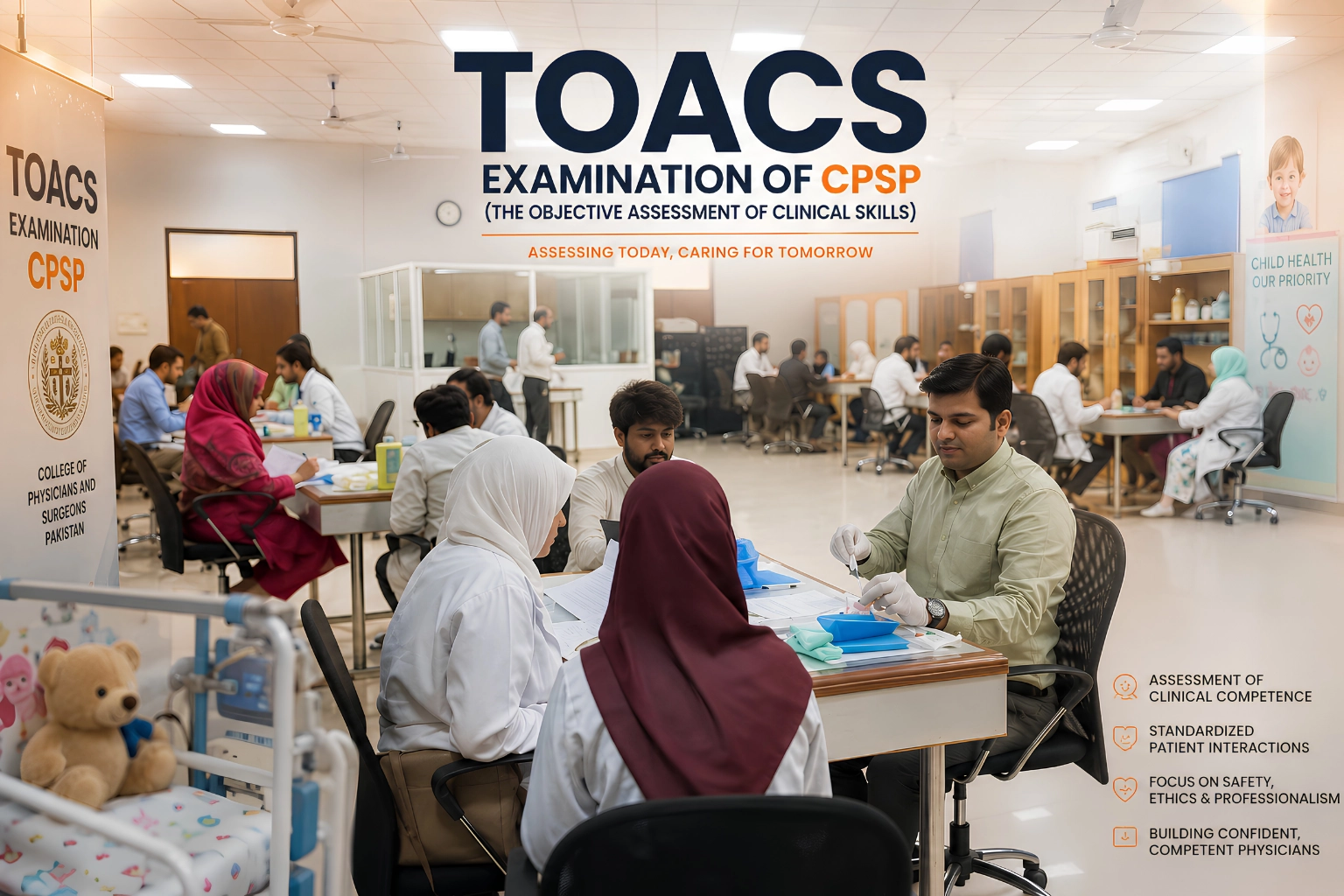
What happens after I pass the theory? You become eligible for the TOACS component, and CPSP rules govern how many consecutive TOACS sittings your theory pass remains valid for. Check the current position in the guidelines before you plan.
Sources and resources
- Watch the full webinar, the hour-long session this article is drawn from
- CPSP IMM examination guidelines, for the paper structure, duration and results process
- College of Physicians and Surgeons Pakistan, for application forms, eligibility and exam centres
- Nelson Textbook of Pediatrics, 22nd edition, for targeted topic reading
- Rudolph’s Pediatrics, for conceptual clarity on difficult topics
- Pre-Test Pediatrics, for question volume
- UpToDate, for resolving contested or recently updated management points