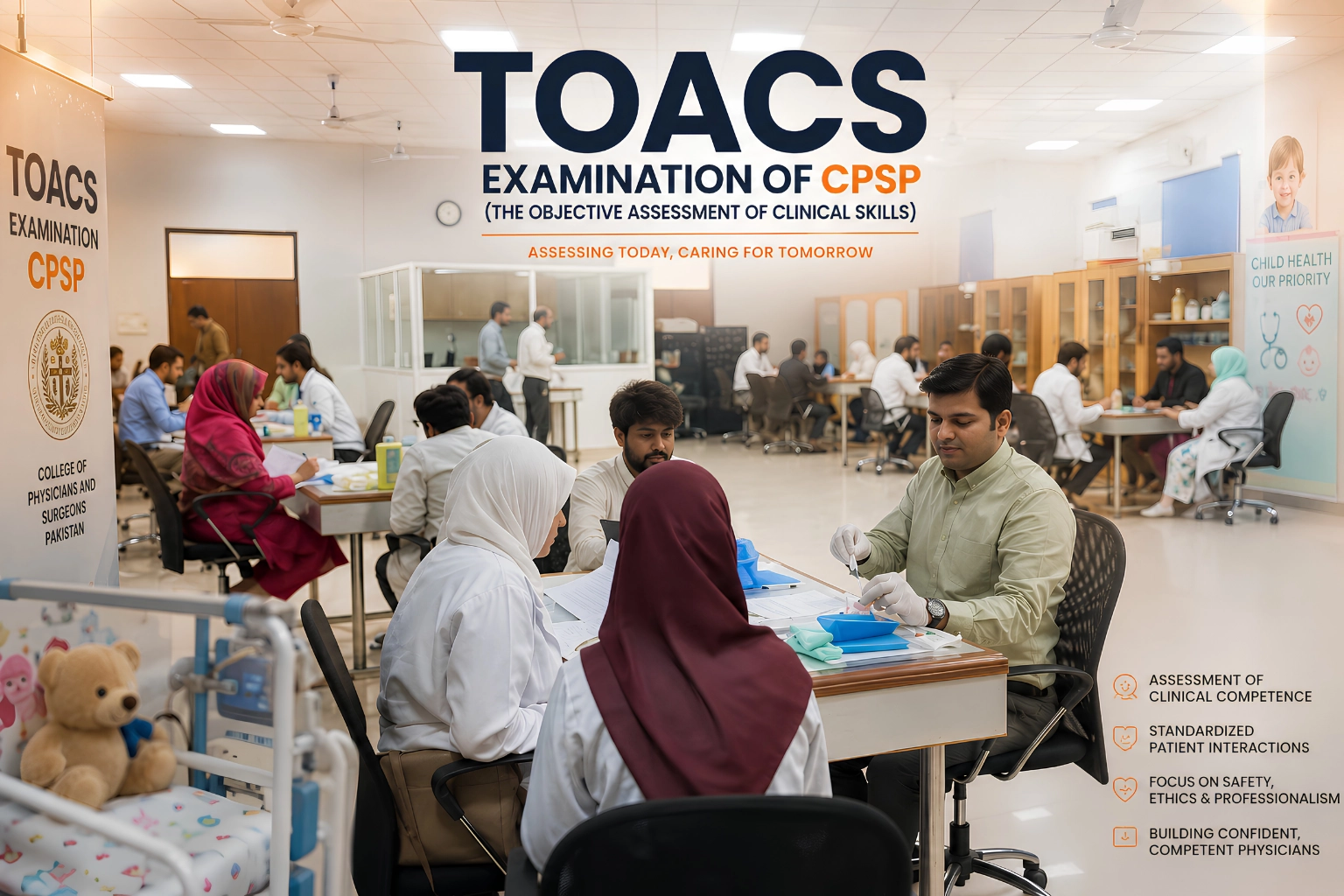

Ask any candidate who has just failed FCPS-1 what went wrong and you will usually hear one of three answers. The paper was unusually hard. The questions were out of syllabus. There were too many clinical scenarios this time. What you rarely hear is the honest one, which is that they studied for two hours on a good day, three or four days a week, and told themselves that solving past papers would cover the rest.
That is the pattern I see most often, and it is the reason this article exists. FCPS-1 does not fail people who prepare. It fails people who confuse activity with preparation. Below is what proper preparation actually looks like, why the old shortcuts have stopped working, and how to build a schedule that survives a house job. If you want the full subject-by-subject breakdown, our FCPS-1 Guidelines covers book selection for every specialty.
The uncomfortable arithmetic
FCPS-1 asks for roughly 75% correct. Not 50%. Not a scaled pass that shifts kindly in a difficult sitting. Around three quarters of a two hundred question paper spanning anatomy, physiology, pathology, pharmacology, biochemistry, microbiology, immunology, embryology, histology, neurology and biostatistics, plus a second paper on your own specialty.
Now consider what most candidates actually put in. Two hours after a shift, on the days they manage it. Call it eight to ten hours a week. Over four months that comes to somewhere near a hundred and sixty hours, spread thin across eleven subjects, with no repetition and no consolidation.
FCPS-1 requires six to eight hours a day of real study. I know how that sounds to someone doing a house job. I am not going to soften it, because softening it is exactly what leads people into a second and third attempt.
What that number really means is this: FCPS-1 done properly is not compatible with a full clinical load done properly. You either take dedicated time, or you accept a much longer timeline and protect your hours ruthlessly, or you sit an exam you are not ready for. Those are the three options. Most candidates who fail chose the third without ever admitting they had chosen it.
The past-paper trap
Here is where I disagree with a lot of the advice circulating in study groups.
There was a time when working through past papers was close to sufficient. Question banks recycled heavily, the same stems reappeared, and a candidate with a good memory and a stack of previous papers could get across the line without deeply understanding much of anything. Seniors who passed that way still recommend it, in good faith, because it worked for them.
It does not work now. The examiners have shifted toward clinical scenarios that test whether you can apply a concept rather than whether you have seen a question before. The paper does not ask you what the pathology of myocardial infarction is. It gives you a fifty-eight year old man with crushing central chest pain, diaphoresis, ST elevation in leads II, III and aVF, and asks which vessel is involved. If you memorised an answer key, you have nothing. If you understood the coronary territories, you have the mark.
So past papers are still valuable, but their role has changed completely. They are no longer the syllabus. They are a diagnostic tool: a way of finding out which topics you have understood and which you have only recognised. Used after theory, they are indispensable. Used instead of theory, they are how people fail twice.
What proper study actually looks like
There is a large research literature on this and it is remarkably consistent. The techniques that feel productive are mostly the ineffective ones.
Rereading notes, highlighting, and reviewing slides are among the least effective ways to encode information for the long term. They produce a comfortable sense of familiarity that has almost no relationship to whether you can retrieve the fact under exam conditions.
| What feels productive | What actually builds retention |
|---|---|
| Rereading chapters | Closing the book and writing out what you remember |
| Highlighting as you read | Answering questions before you have “finished” a topic |
| Watching lectures passively | Explaining a mechanism aloud in your own words |
| Studying one subject in long blocks | Alternating between related topics in a session |
| Cramming in the final weeks | Returning to the same material at widening intervals |
| Recognising an answer as familiar | Retrieving it cold, then checking it |
Two principles do most of the work.
Active recall. Testing yourself rather than reviewing. It is harder than rereading, and that difficulty is the point. Research on desirable difficulties shows that tasks requiring real effort produce better long-term performance even though they slow you down at first, while easy passive review produces better short-term performance and worse retention. If revision feels comfortable, it is probably not working.
Spaced repetition. Returning to material at increasing intervals rather than all at once. Studying for eight hours spread over two weeks generally beats eight hours in one sitting. This is precisely why cramming fails and why the final-month panic revision so many candidates rely on produces so little.
One caution on active recall that catches people out: always check your answers. Practising retrieval without verifying accuracy means you may be reinforcing something wrong, repeatedly, with confidence.
Fewer books, more revisions
The most common reason candidates fail is not a shortage of resources. It is an excess of them.
Collecting books, switching between sources, adding one more reference because someone in a WhatsApp group recommended it — all of this feels like progress and destroys retention. You finish one book, move to the next, and by the time you return the first has faded completely.
Two books revised four times each will outperform eight books read once, every time. A well-annotated, battle-worn copy of First Aid beats a shelf of pristine references that were opened twice.
The revision cycle works roughly like this:
- First pass: you are meeting the content. Expect confusion. That is normal and it is not a sign you have chosen the wrong book.
- Second pass: patterns start forming. Concepts begin connecting to each other.
- Third pass: recall gets faster. This is where you should switch to covering the page and testing yourself rather than reading.
- Fourth pass and beyond: this is where exam-ready confidence actually comes from.
Each cycle is faster than the last. A book that took three weeks the first time may take five days by the fourth. That is not cutting corners; that is what consolidation looks like.
A schedule that survives a rota
Six to eight hours a day is the target. Here is how to get closer to it than you currently are.
Protect the morning. The two hours before your shift are worth more than four hours after it, because you have not yet spent your attention. Candidates who study only in the evening are studying with whatever is left over, which on a bad day is nothing.
Block, do not scatter. Two uninterrupted ninety-minute sessions beat five hours of studying with a phone nearby. Interleave between related topics within a session rather than grinding one subject until you resent it.
Put questions in from day one. Not after you finish theory. Alongside it, from the first week, so that every chapter is immediately tested rather than filed away untested.
Log your hours honestly for one week before you plan anything. Most candidates are shocked by the real number. You cannot fix a deficit you have not measured, and almost everyone overestimates by a factor of two.
Review your wrong answers properly. For each one, write down why: knowledge gap, misread stem, or rushed. Those three problems have different solutions, and candidates who do not separate them keep making the same mistake in the same way.
How to know if you are actually ready
Not by how much you have read. By whether you can do these things:
- Explain a mechanism out loud, without notes, to someone who does not know it
- Score consistently on timed blocks of unseen questions, not questions you have done before
- Recall the high-yield differentiators cold — Marfan versus homocystinuria, Type II versus Type III hypersensitivity, nephrotic versus nephritic, botulinum versus tetanus toxin
- Complete a full revision of your primary book in under a week
- Look at a wrong answer and immediately identify which of the three failure types it was
If you cannot do most of those, you are not ready, regardless of how many months you have been at it or how many past papers you have solved.
Where to go from here
The candidates who pass FCPS-1 are not smarter than the ones who fail. In my experience they differ in two ways: they were honest with themselves about how many hours they were actually putting in, and they treated past papers as a test of their preparation rather than a substitute for it.
Start by logging a week of real study hours. Then pick your books, one per subject, and commit to revising them rather than adding to them. Our FCPS-1 Guidelines sets out exactly which book to use for each subject and each specialty, including where Anaesthesia, Pathology and Gynae and Obs candidates need to diverge from the general list.
If you would rather have structure and accountability than build it alone, our FCPS-1 course runs on a fixed schedule with timed assessments and consultant-led sessions. You can also browse our other FCPS-1 preparation guides or meet the faculty.
Sources and further reading
- Med School Insiders: 7 evidence-based study strategies
- UNC Learning Center: Studying 101 — study smarter, not harder
- College of Physicians and Surgeons Pakistan — for current examination regulations, dates and fees
Frequently Asked Questions
How many hours a day do I really need to study for FCPS-1?
Six to eight hours of focused study. That is the honest figure, and it is why FCPS-1 is difficult to prepare for properly alongside a full clinical load. Candidates managing two or three hours a day need to extend their timeline accordingly rather than sitting the exam under-prepared.
Are past papers still enough to pass FCPS-1?
No. They were closer to sufficient several years ago, when questions recycled heavily. The paper has moved toward clinical scenarios that test application rather than recall of a previously seen stem. Past papers remain valuable as a way of testing your preparation and identifying weak areas, but they are no longer a substitute for covering theory.
Is it better to read many books or revise a few repeatedly?
A few, revised repeatedly. Two books revised four times each will outperform eight books read once. Switching sources feels productive but prevents anything consolidating into long-term memory.
When should I start solving MCQs?
From the first week, alongside your reading, not after you finish it. Questions used during learning reveal what you have actually understood; questions used only at the end reveal it too late to fix.
Why do I keep forgetting what I studied a month ago?
Because you almost certainly studied it once, passively. Retention comes from returning to material at widening intervals and from retrieving it from memory rather than rereading it. Reading a chapter and recognising the content later is not the same as being able to produce it under exam conditions.
Is there negative marking in FCPS-1?
No. There is no penalty for a wrong answer, so leave nothing blank.